
State Media in the Middle East: A Region Built on State Control
Middle East — Key findings
14 SMM-tracked countries and territories · State Media Monitor 2026 · Regional analysis
SC · State-Controlled | CaPu · Captured Public / State-Managed | CaPr · Captured Private | ISFM · Independent State-Funded and State-Managed. RSF 2026 category thresholds by score: Good 85–100 · Satisfactory 70–85 · Problematic 55–70 · Difficult 40–55 · Very Serious 0–40. Sources: State Media Matrix typology; RSF 2026 World Press Freedom Index.
Middle East — Key indicators
14 SMM-tracked countries and territories · State Media Monitor 2026
SC = State-Controlled; ISFM = Independent State-Funded and State-Managed. Typology counts from State Media Monitor 2026 country profiles (main database); two of the region’s lowest-scoring countries, Iran (17.45) and Saudi Arabia (19.11), are among the five lowest in the entire global Index. RSF data from the 2026 World Press Freedom Index.
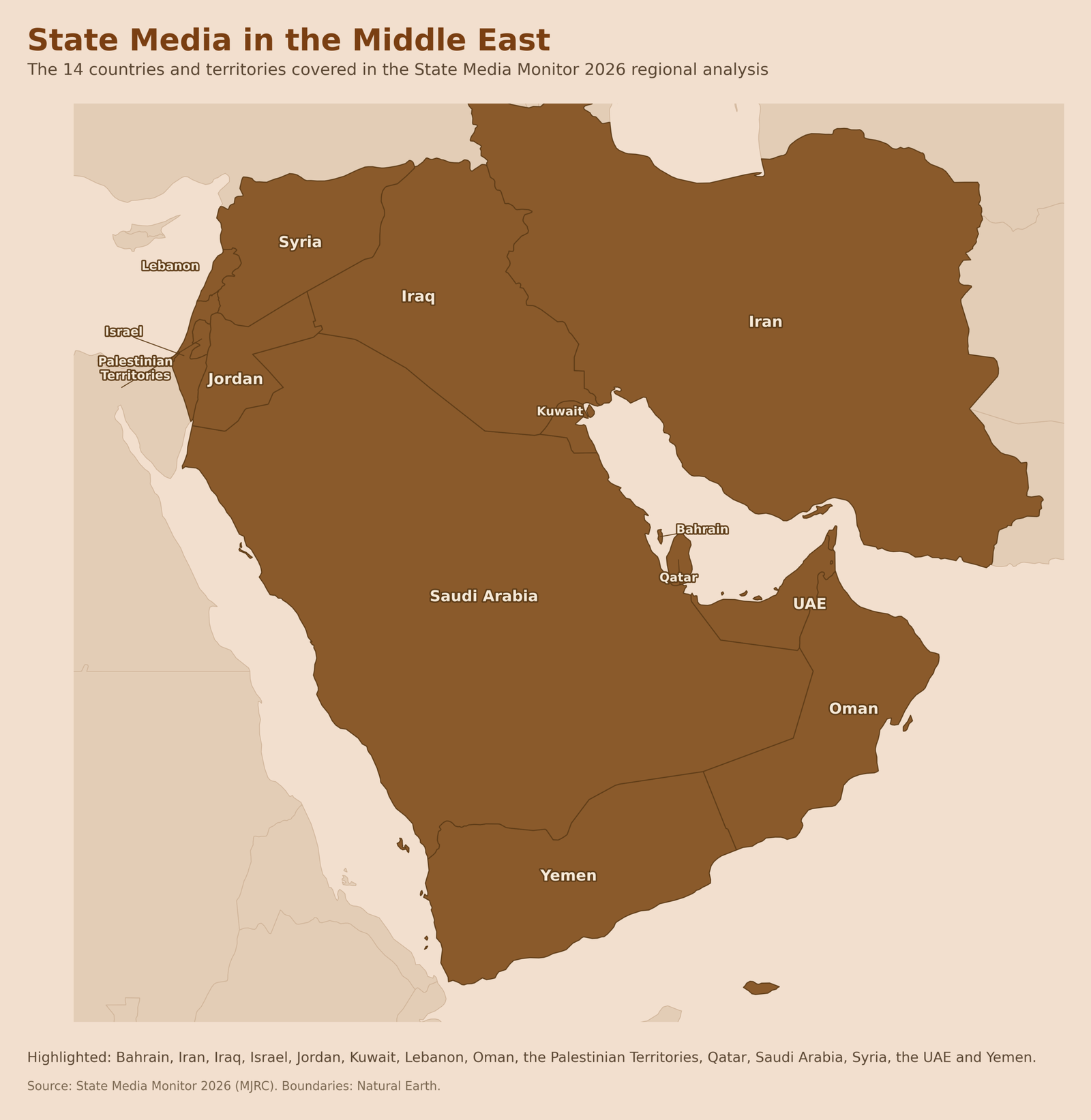
The 14 Middle Eastern countries and territories assessed in the State Media Monitor 2026 cycle (Bahrain, Iran, Iraq, Israel, Jordan, Kuwait, Lebanon, Oman, the Palestinian Territories, Qatar, Saudi Arabia, Syria, the United Arab Emirates and Yemen) together account for roughly 290 million people and span the full range of the region’s political systems, from Gulf monarchies and a clerical republic to fragile transitional and partitioned states. Across that diversity, State-Controlled (SC) classification is the structural rule rather than the exception: 13 of the 14 contain at least one SC outlet, and in most of them the entire profiled state-media sector sits in that tier of the State Media Matrix typology, the one in which public-media institutions are operated as government departments, ministry directorates or wholly state-owned corporations without meaningful arm’s-length protection.
The single exception is structural rather than marginal. Israel is the only country in the region whose profiled outlets, the Israeli Public Broadcasting Corporation (Kan) and the army station Galatz, are classified Independent State-Funded and State-Managed (ISFM) rather than SC, yet both were placed on the State Media Monitor watch list for the 2026 cycle as sustained legislative and administrative pressure on each was held off largely through repeated High Court interventions. The other departures from a pure SC pattern are captured rather than independent: Captured Public (CaPu) outlets in Jordan, the UAE, Saudi Arabia and the Palestinian Territories, and Captured Private (CaPr) outlets in Qatar and the Palestinian Territories, with a further set of CaPr titles recorded for Iran on the wider Global State Media List. The architectural model is consistent across sub-region, from the Gulf broadcaster-plus-news-agency pairings, Kuwait’s KTV, Kuwait Radio and KUNA; Bahrain’s BRTC and BNA, through the ministry-directorate systems of Lebanon, Oman and post-Assad Syria to the single consolidated network in Iraq, the Iraqi Media Network.
Press-freedom outcomes are far less uniform than the typology, and they cluster heavily toward the bottom of the scale. The Reporters Without Borders 2026 World Press Freedom Index, published in April 2026 amid a global press-freedom low in which more than half of all countries now sit in the “difficult” or “very serious” bands, places the region across only the lower three of the five RSF categories. No Middle Eastern country reaches “good” or even “satisfactory.” A single country, Qatar, sits in the “problematic” band, at 75th globally with a score of 59.79, a position RSF notes it has held as regional leader since 2023. Two of the five lowest-ranked countries in the entire global Index, Iran and Saudi Arabia, are in this region. RSF identifies MENA as the world’s worst region for press freedom and describes the Middle East as one of the two most dangerous regions for journalists, a judgement underscored by Palestine’s status as the world’s most dangerous country for the press.
Middle East — Country ranking
14 countries and territories · SC-dominant architecture in 13 of 14 · Ranked by RSF 2026 World Press Freedom Index (best to worst)
| Country | Pop ~M | SMM Typology | RSF 2026 | Δ ’25 | Score | Category |
|---|---|---|---|---|---|---|
| Qatar | 3.1 | SC · CaPr | 75 | +4 | 59.79 | Problematic |
| Lebanon | 5.8 | SC | 115 | +17 | 46.49 | Difficult |
| Israel | 9.4 | ISFM | 116 | −4 | 46.46 | Difficult |
| Oman | 5.4 | SC | 127 | +7 | 43.67 | Difficult |
| Kuwait | 4.9 | SC | 136 | −8 | 40.44 | Difficult |
| Syria | 25.0 | SC | 141 | +36 | 39.44 | Very Serious |
| Jordan | 11.5 | SC · CaPu | 142 | +5 | 39.33 | Very Serious |
| Palestinian Territories | 5.5 | SC · CaPu · CaPr | 156 | +7 | 32.09 | Very Serious |
| United Arab Emirates | 11.0 | SC · CaPu | 158 | +6 | 30.86 | Very Serious |
| Iraq | 46.0 | SC | 162 | −7 | 28.85 | Very Serious |
| Yemen | 40.0 | SC | 164 | −10 | 27.89 | Very Serious |
| Bahrain | 1.7 | SC | 170 | −13 | 24.84 | Very Serious |
| Saudi Arabia | 34.0 | SC · CaPu | 176 | −14 | 19.11 | Very Serious |
| Iran | 90.0 | SC | 177 | −1 | 17.45 | Very Serious |
SMM Typology shows the typology categories present in each country’s profiled state-media outlets. “SC” = State-Controlled; “CaPu” = Captured Public / State-Managed; “CaPr” = Captured Private; “ISFM” = Independent State-Funded and State-Managed. Israel is the only country with no SC outlet: its two profiled outlets (Kan, Galatz) are ISFM and both are on the SMM watch list. Iran’s typology shown is its main-database profiling (six SC outlets); a further seven CaPr titles are recorded for Iran on the wider Global State Media List. Yemen’s seven entries and the Palestinian Territories’ five outlets span dual, partitioned authorities. Syria’s mapped SC core (ORTAS, Al-Wahda Foundation, SANA) is unchanged in typology despite the cycle’s historic ranking rise.
RSF 2026 categories assigned by score: Good 85–100 · Satisfactory 70–85 · Problematic 55–70 · Difficult 40–55 · Very Serious 0–40. Δ ’25 = change in RSF rank vs 2025 (+ = improved). All 14 scores RSF-verified. Populations are approximate.
The most consequential finding cuts across the two datasets. Within an institutional template that is almost uniformly State-Controlled, it is press-freedom variation, not typological variation, that tells the story of the cycle, and that variation tracks political events rather than any movement toward structural media independence. Not one country in the region has produced, during this cycle, the combination of arm’s-length appointment, ring-fenced public funding and operationalised editorial-governance safeguard that would meet the State Media Monitor threshold for an Independent Public-Service Broadcasting classification. The nearest the region comes is Israel’s two ISFM outlets, and there the cycle’s defining feature was the effort to roll that independence back: an attempted closure of the army station and a prolonged squeeze on the public broadcaster’s budget and governing council, checked for now by the courts rather than secured by statute.
Where state media changed character this cycle, it did so because the state changed, dramatically in Syria, incrementally in Lebanon’s post-vacancy reconstitution and through modest reform or stabilisation effects in parts of the Gulf, rather than because any arm’s-length institution took root. The captured-media exceptions reinforce the point: the CaPu and CaPr outlets in Jordan, the UAE, Saudi Arabia, Qatar, the Palestinian Territories and on Iran’s wider list reflect specific ownership and commercial-form legacies, newspaper foundations under state-linked shareholding, ruling-family media empires and party-aligned private titles, rather than emerging pluralism. The region’s two partitioned cases make the same structural logic visible in extreme form: in the Palestinian Territories, the State Media Monitor maps parallel Palestinian Authority and Hamas-aligned architectures, and in Yemen a single divided inheritance of state broadcasters and news agencies runs in rival versions on either side of the front line. Across regime type, from Gulf monarchy to clerical republic to transitional administration, the Middle East converges on the same State-Controlled architecture, and it is the RSF data, spread across the Index’s lower bands, that records where the experience of journalism within that architecture is merely constrained and where it is dangerous.
June 2026
Citation (cite the article/profile as part of):
Dragomir, M. (2025). State Media Monitor Global Dataset 2025.
Media and Journalism Research Center (MJRC).
Zenodo.
https://doi.org/10.5281/zenodo.17219015
This article/profile is part of the State Media Monitor Global Dataset 2025, a continuously updated dataset published by the Media and Journalism Research Center (MJRC).