State Media in Northern Africa: One Architecture, No Independent Exception
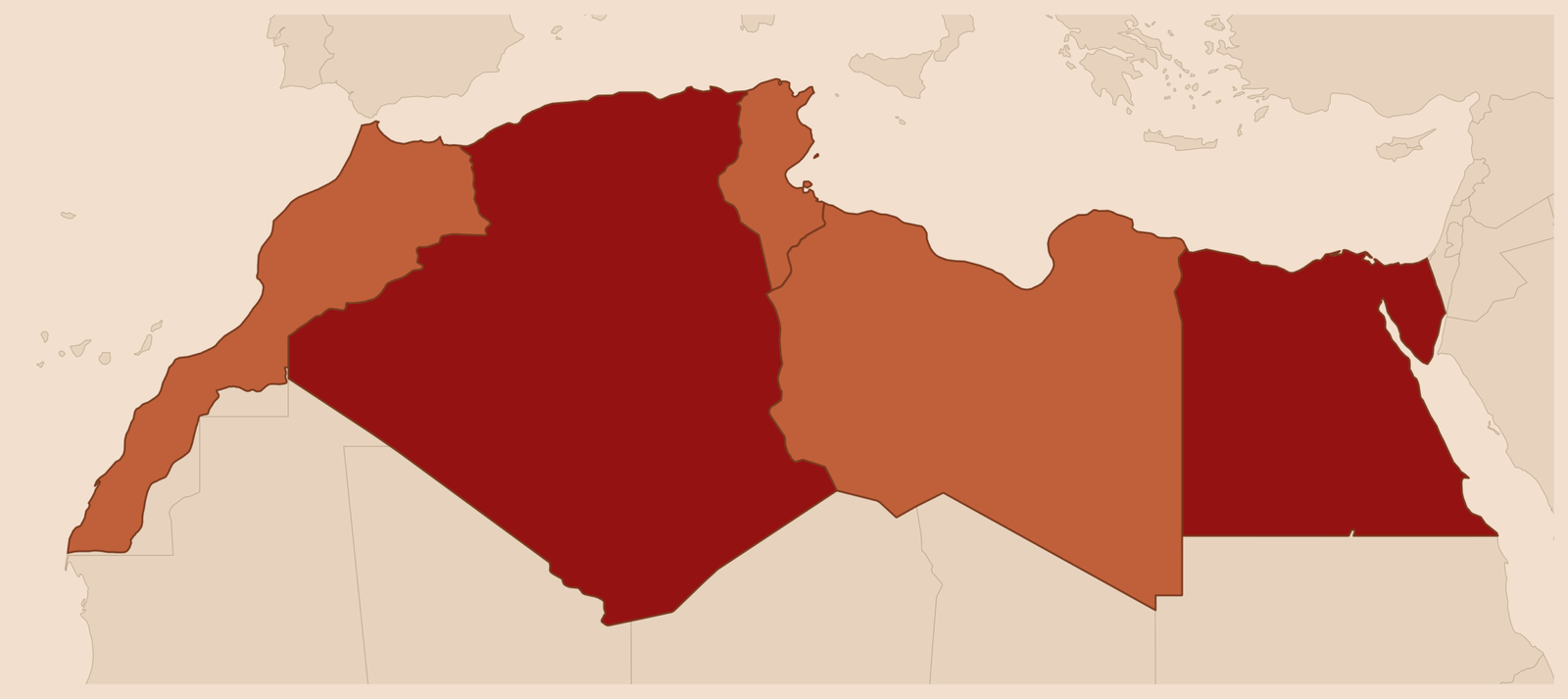
The five Northern African countries assessed in the State Media Monitor 2026 cycle, Algeria, Egypt, Libya, Morocco and Tunisia, together account for roughly 220 million people and span a monarchy, security- or military-dominated republics, and a partitioned transitional state. Across that political range, State-Controlled (SC) classification is not merely common but structural: all five countries contain at least one SC outlet, and the region’s 20 profiled state-linked outlets divide into 13 SC, five Captured Public (CaPu) and two Captured Private (CaPr), with not a single outlet classified Independent Public-service (IP) or Independent State-Funded and State-Managed (ISFM). Where the State Media Monitor’s Middle East analysis found one structural exception in Israel’s two ISFM outlets, Northern Africa offers none. The region’s only departures from a pure SC pattern are forms of capture, not independence.
The captured tier is where the sub-region’s internal variation lives, and it splits along an ownership line. In Algeria and Tunisia, the non-SC outlets are Captured Public: state-owned newspaper and publishing houses, Algeria’s El Moudjahid, Ech Chaab, El Djoumhouria and Horizons, and Tunisia’s SNIPE-La Presse, that are wholly or majority publicly owned but run as commercial companies rather than as arm’s-length public-service institutions. In Morocco, the two non-SC outlets are Captured Private: the Maroc Soir group and La Nouvelle Tribune, privately held titles bound to the political and economic establishment rather than to the state’s own balance sheet. Egypt and Libya, by contrast, are SC-only in their profiled outlets. Egypt’s three entries, the National Media Authority, the National Press Authority and the Egyptian Media Group / United Media Services structure, between them concentrate a large broadcasting, publishing, news-agency and production apparatus under state and security-linked control, while Libya’s single profiled outlet, the Libyan News Agency, runs in parallel Tripoli and Benghazi editions that mirror the country’s territorial division.
The building blocks repeat across the region: a dominant state broadcaster paired with an official news agency, most often with a state-owned or state-aligned print arm. But the governing architecture comes in three distinct forms. Three countries run a single-authority model, in which one ministry, palace or executive centre oversees the public-media sector. Algeria’s public television and radio establishments sit beside the APS news agency and four state-owned dailies, all under the state’s communication architecture, with the state advertising agency ANEP as a decisive economic lever. Morocco’s SNRT, enlarged this cycle by the consolidation of 2M and Medi1 assets under public-broadcaster control, pairs with the MAP news agency, which itself spans agency, publishing, television and radio. Tunisia’s ETT, Radio Tunisienne and TAP form an SC core alongside the CaPu publisher SNIPE-La Presse, all answering to the executive.
Egypt and Libya depart from that single-authority template in opposite directions. Egypt concentrates the spectrum into three parallel state-controlled structures: the National Media Authority for broadcasting, the National Press Authority for state press institutions and the MENA news agency, and the Egyptian Media Group / United Media Services structure, a nominally private conglomerate held through a state security-linked vehicle, which the State Media Monitor classifies SC rather than captured because of that ownership and control structure. Libya departs not by design but by collapse: its state-media inheritance has fractured along the country’s territorial divide, so that the single mapped outlet, the Libyan News Agency, runs as parallel Tripoli and Benghazi editions under rival authorities, each independently meeting the determinants of state control.
What the region does not have is as significant as what it has. Not one of these institutions, in any of the five countries, combines arm’s-length appointment, ring-fenced public funding and an operationalised editorial-governance safeguard to the standard that would earn an Independent Public-service classification. Where regulators exist on paper, they do not function as independent checks. Tunisia’s HAICA has been left without a normally renewed and fully functioning leadership structure since 2023, and across the region the appointment of broadcaster and agency chief executives runs through presidential palaces, royal cabinets, governments or security-linked structures rather than through insulated boards. The captured outlets reinforce the same logic from the public and private sides: state-linked newspaper foundations in Algeria and Tunisia, establishment-bound private titles in Morocco, and no emerging independent public-service pole.
Press-freedom outcomes are far less uniform than the typology, and they track political and security conditions rather than any movement toward structural independence. The Reporters Without Borders 2026 World Press Freedom Index, published at a time when RSF describes global press freedom as being at a 25-year low, places all five Northern African countries in its lower two bands. Three sit in the “difficult” category, Morocco, 105th with a score of 50.55; Tunisia, 137th with 40.43; and Libya, 138th with 40.34, and two in “very serious”: Algeria, 145th with 37.38, and Egypt, 169th with 24.92. None reaches “problematic” or above.
| Country | Pop ~M | SMM Typology | RSF 2026 | Δ ’25 | Score | Category |
|---|---|---|---|---|---|---|
| Morocco | 38 | SC · CaPr | 105 | +15 | 50.55 | Difficult |
| Tunisia | 12 | SC · CaPu | 137 | −8 | 40.43 | Difficult |
| Libya | 7.3 | SC | 138 | −1 | 40.34 | Difficult |
| Algeria | 46 | SC · CaPu | 145 | −19 | 37.38 | Very Serious |
| Egypt | 116 | SC | 169 | +1 | 24.92 | Very Serious |
The year’s movements are sharply divergent and event-driven. Morocco rose 15 places, the region’s clear outlier on direction, although RSF still records pressure on independent journalists, including lawsuits, financial pressure and editorial influence. Tunisia fell eight places as Decree-Law 54 lawfare, media suspensions and the instrumentalisation of the courts deepened, and Algeria fell 19, the steepest regional drop, amid detentions, censorship and online harassment of independent newsrooms. Libya slipped one place in a divided landscape where journalists are pushed toward self-censorship by a cybercrime law and pressure from rival authorities. Egypt, despite a marginal one-place rise to 169th, remains the region’s lowest-ranked country and, according to RSF, one of the world’s biggest jailers of journalists.
The most consequential finding cuts across both datasets. Northern Africa has converged, across monarchy, security- and military-dominated republics, and partitioned state alike, on an SC-centred state-media architecture, and it has done so without producing anywhere the arm’s-length public-service institution that would represent a structural alternative. Where state media changed character this cycle, in Morocco’s consolidation of its broadcasters, Tunisia’s merger of its public press into a single state-managed pole, and Libya’s continued fragmentation, it changed in the direction of more concentrated state control, not less. The region’s captured outlets are the inheritances of particular ownership histories, not the seeds of pluralism, and the absence of even one IP or ISFM outlet across five countries and 20 entities is the defining structural fact of Northern African state media in 2026.
Citation (cite the article/profile as part of):
Dragomir, M. (2025). State Media Monitor Global Dataset 2025.
Media and Journalism Research Center (MJRC).
Zenodo.
https://doi.org/10.5281/zenodo.17219015
This article/profile is part of the State Media Monitor Global Dataset 2025, a continuously updated dataset published by the Media and Journalism Research Center (MJRC).