
State and Public Media in South Asia: Reform on Paper, Control in Practice
State media in South Asia
2026 cycle · eight countriesSources: State Media Monitor country and outlet profiles, 2026 cycle; Reporters Without Borders, 2026 World Press Freedom Index; national legislation, audited accounts and government records. Classification per the State Media Matrix.
Press freedom — South Asia
RSF Index 2026Source: Reporters Without Borders, 2026 World Press Freedom Index. Bars show the country score on the Index’s 0–100 scale, drawn to a 60-point axis since all eight scores fall below 55. Pakistan’s score is taken from the RSF 2026 data file.
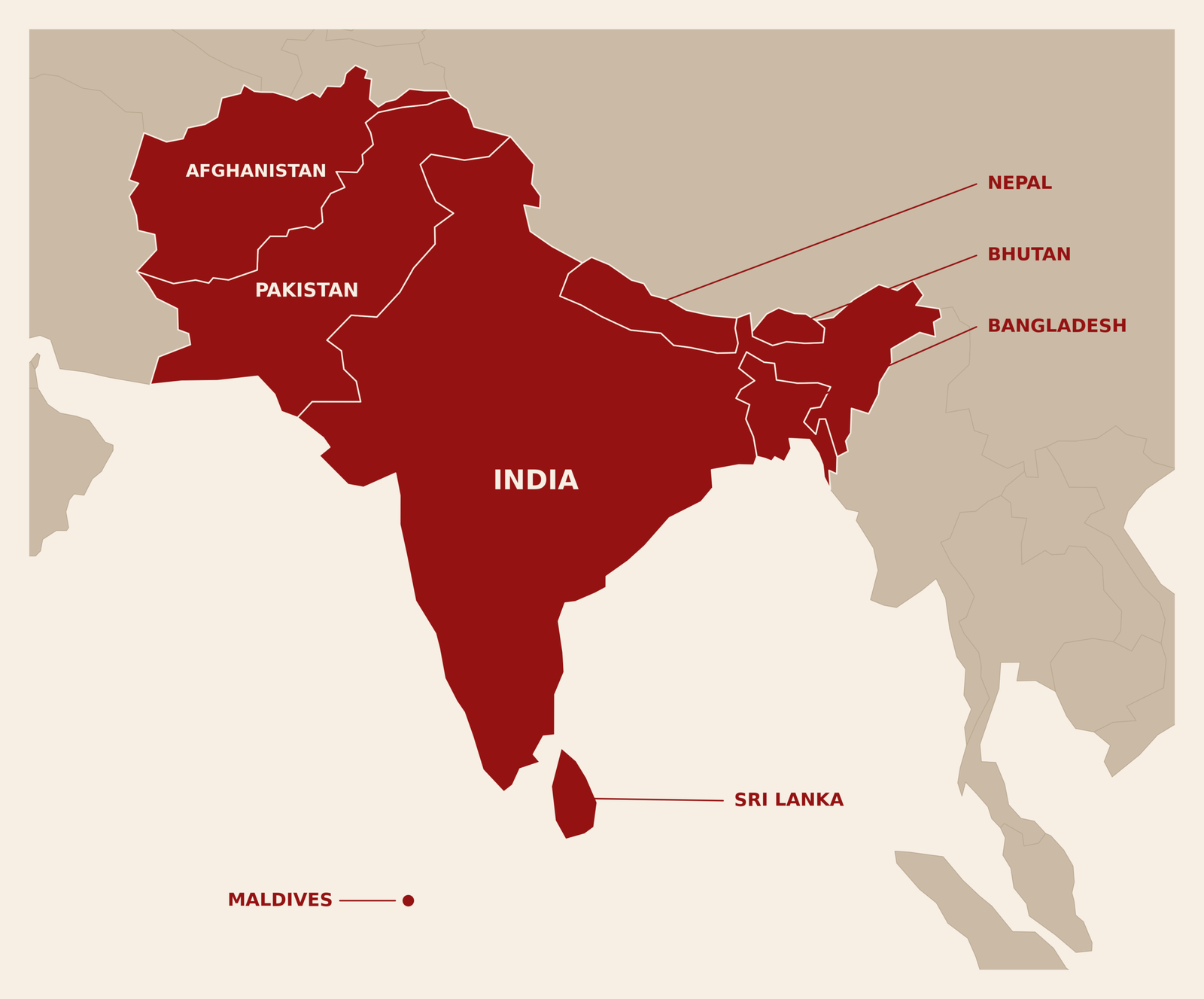
South Asia holds close to 1.99 billion people, roughly a quarter of humanity, across eight countries ranging from India’s 1.46 billion to the Maldives’ half a million. It is also, on the 2026 RSF World Press Freedom Index, a subregion without a single country rated better than “difficult.” Nepal, the Maldives and Sri Lanka occupy that band; Bhutan, Bangladesh, Pakistan, India and Afghanistan are all classified very serious. The 88-place spread from Nepal at 87th to Afghanistan at 175th is narrower than Central America’s 130, but its ceiling is far lower: Costa Rica sits in the satisfactory band, while South Asia’s best-placed country does not reach problematic.
State Media Monitor maps 21 state-media organisations across these eight countries. Fifteen, roughly seven in ten, are State-Controlled, meeting all three Matrix conditions of predominant state funding, state ownership or governance, and editorial control. Five are Captured Public, four of them in Sri Lanka. Exactly one falls in the independent family: Kuensel, Bhutan’s national newspaper, majority state-owned but classified Independent State-Managed/Owned because its editorial autonomy is demonstrated in practice rather than protected by law.
That single exception defines the subregion. Five of eight countries, Afghanistan, Bangladesh, India, the Maldives and Pakistan, map nothing but State-Controlled outlets. No country has an independently governed national public broadcaster. Kuensel’s independence is behavioural, not institutional.
The Captured Public classifications carry a similar caution. In Sri Lanka they reflect commercial or undocumented funding rather than editorial independence: SLRC records no recurrent operating subsidy, ITN’s government financing runs at about 5.6% of income, SLBC’s at roughly 27%, while ANCL’s share of public advertising is not disclosed at all.
Two organisations were reclassified in 2026, and both moved on the funding indicator alone. Pakistan Television Corporation entered State-Controlled after the electricity-bill licence fee that had supplied most of its income was abolished and replaced by direct federal support (PKR 11 billion for FY2025–26, and a further PKR 13 billion approved on 4 August 2026). Nepal’s Rastriya Samachar Samiti moved the other way, out of State-Controlled, because no audited breakdown demonstrates that state support reaches half its budget. Neither change reflected any shift in editorial autonomy.
Elsewhere the year’s developments ran through governance rather than classification. Nepal removed 1,594 public appointees by ordinance in May 2026, including state-media leadership, overriding statutory terms; the ordinance later expired while the dismissals stood. Sri Lanka replaced the chairmen of its four principal state-media companies within four days of a presidential election. Bangladesh’s Media Reform Commission saw none of its 100-plus recommendations implemented. Bhutan’s 2018 statutory designation of BBS as public service broadcaster remained without the charter the law requires, eight years on.
Typology by country — South Asia
21 entries · 2026Countries ordered by 2026 RSF World Press Freedom Index rank, best to worst. Source: State Media Monitor Global List 2026. Classification per the State Media Matrix.
Citation (cite the article/profile as part of):
Dragomir, M. (2025). State Media Monitor Global Dataset 2025.
Media and Journalism Research Center (MJRC).
Zenodo.
https://doi.org/10.5281/zenodo.17219015
This article/profile is part of the State Media Monitor Global Dataset 2025, a continuously updated dataset published by the Media and Journalism Research Center (MJRC).