Independent by Exception: State Media Monitor 2026 Global Study Released
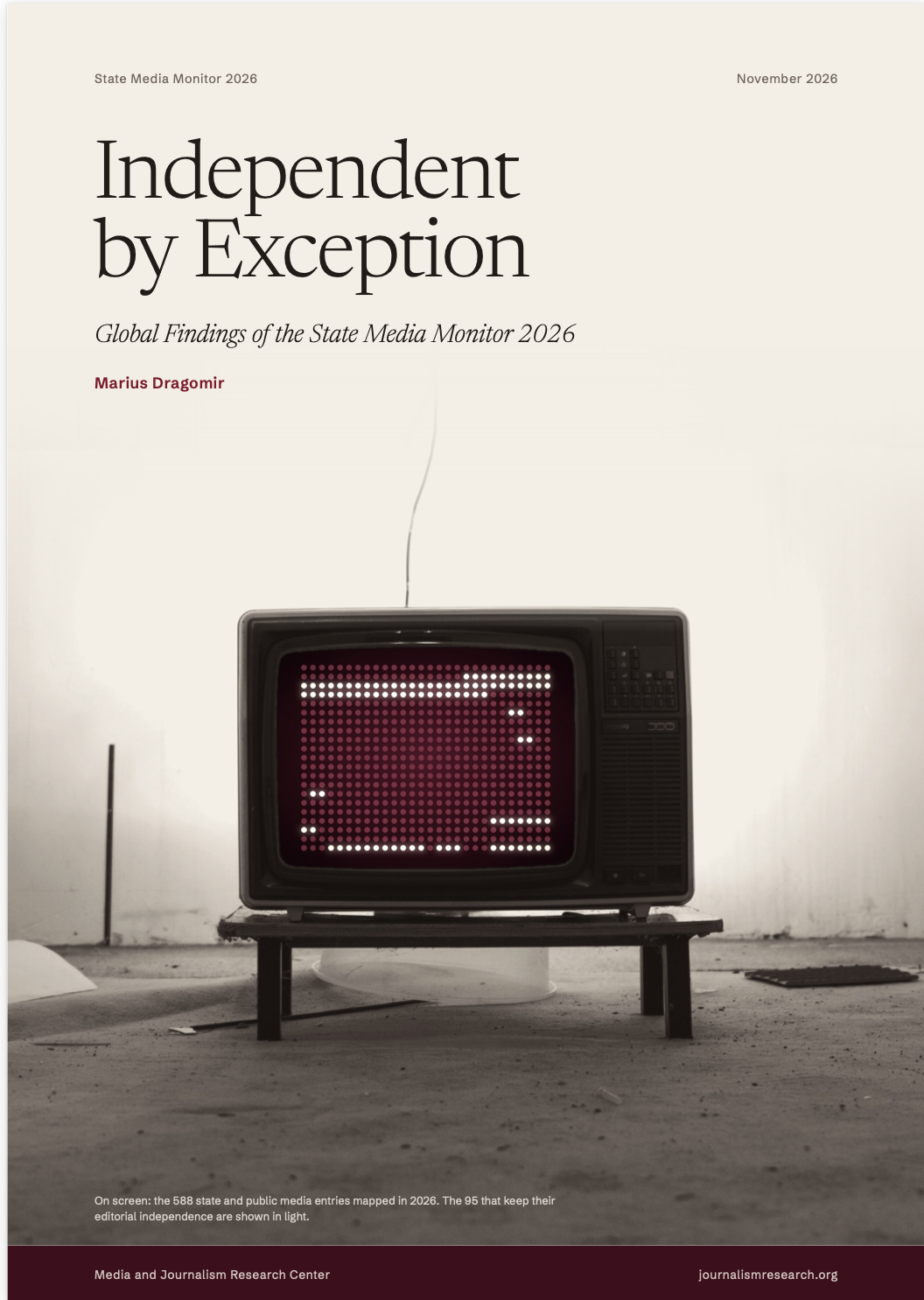
The Media and Journalism Research Center (MJRC) has published Independent by Exception: Global Findings of the State Media Monitor 2026, the annual global study of state and public media by Marius Dragomir. The 2026 edition maps 588 active state and public media entries in 168 jurisdictions. Of these, 493, or 83.8 per cent, are controlled or captured by governments, ruling parties or interests tied to the state. The remaining 95 keep their editorial independence.
The non-independent share fell from 84.6 per cent in 2025, the first improvement in the five-cycle series. The change comes from the composition of the mapping. Six European public media gained independent status while six entries elsewhere lost it, and among the 574 entries mapped in both years the independent count stayed at 92.
Key findings
- Europe: For the first time since 2022, independent entries form a majority of the European mapping: 59 of 105, or 56.2 per cent. Spain’s RTVE and Czech Radio were among six public media upgraded, and none was downgraded.
- The rest of the world: Outside Europe, the non-independent share rose for the fourth consecutive cycle, from 90.6 per cent in 2022 to 92.5 per cent.
- Downgrades: All six entries reclassified out of the independent family are outside Europe. They include Indonesia’s TVRI and RRI, which returned to State-Controlled one year after their upgrade.
- Sub-Saharan Africa: 143 of 145 entries (98.6 per cent) are non-independent, and the region holds a third of the world’s State-Controlled media.
- Middle East and North Africa: After Sky News Arabia was reclassified Captured Public, only Israel’s Kan and Galatz remain independent.
- Independent Public media: The category with the strongest protection from government interference counts 18 entries, or 3.1 per cent of the total.
- A shrinking map: 47 jurisdictions have at least one independent state or public media entry, down from 51 in 2022.
- Money as a lever: Funding freezes, cuts and conditional budgets were a major instrument of pressure on independent public media, from Lithuania and Switzerland to Taiwan.
- Artificial intelligence: In the regions reviewed for AI governance, published AI policies were most widespread among public media in Western and Northern Europe. At most State-Controlled outlets, no published policy could be identified.
Read the study and explore the data
- Read the full study online
- Download the PDF
- Global List: all 588 entries mapped in 2026, by region
- Regional overviews: six regions in depth
- Typology: the seven categories of the State Media Matrix
- All editions of the Global Study
- State Media Monitor Global Dataset 2026 on Zenodo
Cite the study: Dragomir, M. (2026). Independent by Exception: Global Findings of the State Media Monitor 2026. Media and Journalism Research Center. https://doi.org/10.5281/zenodo.23864465